Saturday, July 08, 2006

Trip to Reno, Nevada gave new ideas: textual context for words

I took a couple of days off from Internet Polyglot to drive to Reno, Nevada. The city is nice but albeit it tries to be a second Las Vegas it is far from it. If in Vegas you can go to shows or simply enjoy strolling on the streets, in Reno you have nothing but casinos and boring slots.

Interesting observation - I don't know anybody who would ever win in casino. Still people go there and lose their money. Is it just for fun or there are still some of them who believe in winning?

Anyway, after losing a couple of dozens bucks playing video-poker it brought me back to thinking of how to further improve Internet Polyglot.

The idea is to provide for each word in the Internet Polyglot database a phrase that would show the usage of this word in live context. Of course it would be very hard to do that for each word in each language so I am thinking about the following approach:

1) There will be a way to enter a piece of text by any registered user.
2) This text preferably should be fun to read, for example it can be a joke or a funny story. It even can be copy-and-pasted from public sites that contain well-known jokes and funny stories.
3) This way there will be a library of texts in different languages.
4) On the lesson detail page (the one that contains words and their translations) there will be an icon against each word and translation - when a user moves the mouse over it a popup window appears with a short snippet of some text that contains this word. On the same popup window there is a link that lets the user read the entire text.

Such a feature, I expect, should kill two birds with one stone: first, there will be language context provided for the words and translations; second, there will be more fun learning since the context will contain mostly jokes and funny stories.

And now the joke of the day:

A 90-year-old man said to his doctor, "I've never felt better. I have an 18-year old bride who is pregnant with my child. What do you think about that?"

The doctor considered his question for a minute and then said, "I have an elderly friend who is a hunter and never misses a season. One day when he was going out in a bit of a hurry, he accidentally picked up his umbrella instead of his gun. When he got to the Creek, he saw a rabbit sitting beside the stream. He raised his umbrella and went, 'bang, bang' and the rabbit fell dead. What do you think of that?"

The 90-year-old said, "I'd say somebody else killed that rabbit."

The doctor replied, "My point exactly."

Sunday, July 02, 2006

The site is translated to Polish

Huge thanks to one of our prominent enthusiasts Joanka from Poland! She has done another perfect job - translated the site to Polish. Here is Internet Polyglot in Polish. Check it out!

Tuesday, June 27, 2006

Italian Lessons

Today I have loaded Italian Lessons to Internet Polyglot.

Ah, Italia! Who wouldn't want to this beautiful country with its sun and the sea and famous Italian food?! But does it make sense to go there without knowing at least the basic vocabulary: greetings, hellos, goodbyes? Don't miss your chance, learn these words in this lesson: Saluti, Richieste, Benvenuti, Addii.


Facts about the Italian Language


Italian could probably be considered the direct descendant of Classical Latin spoken in the Roman Empire, at least in terms of vocabulary. Although there are a few other Latin languages that could very well contest this title (such as Romanian, which kept the closest declension rules as Classical Latin or Sardinian which kept most of the phonology) Italian remains the leader of the pack in what regards Latin languages.


Spoken by over 70 million people worldwide (most of them Italian natives of course) the Italian language consists of several dialects which are very close in vocabulary and grammar, but differ slightly in phonology. The Italo-Dalmatian dialect from Southern Italy, the Tuscan dialect or the Gallo-Italian dialect from Northern Italy are 3 such examples.


Learning Italian online


The Internet provides a large variety of sources where you can learn Italian from, including free Italian online lessons, live Italian language videoconferences, downloadable books or “Learn Italian” courses and so for. Depending on the level of difficulty you need, you might want to search out some of the sites offering these services but be aware that the quality level of the lessons also varies dramatically. You’ll be better off studying all your options thoroughly rather than simply charging into the first site you find on Google for the keyword “learn Italian course”.


You should set a few priorities for yourself when looking after one of these sites. First of all, determine how much time and money you can spend on their services. Learning takes quite some time and the prices may vary a lot. For example, a video conference lesson will obviously be more expensive than your average downloadable “How to Learn Italian” course book.


It’s best to scoop around and try to find people that have used a particular site’s services before actually buying them yourself. Just because the site says that you’ll ”receive quality courses” doesn’t mean that it will actually go down that way. If another one of their users could enforce those promises, then you might want to try out their services.


Alternative ways of learning Italian


Another way to increase your Italian language learning speed other than taking free Italian lessons online or subscribing to the many „Learn Italian” courses that you can find on the World Wide Web, you might want to try some slightly more relaxing alternative learning methods. For example, vocabulary games can be a great way to boost your Italian word pool and playing them could also prove to be a means of relaxation. Although their main purpose is to improve vocabulary, you will also get a better grasp on Italian spelling and possibly pronunciation as well and we all know that when we learn something for fun, we learn it better and faster.


Articles about Italian in different languages:

Facts about the Italian Language (in English)
De lengua italiana (in Spanish)
De langue italienne (in French)
Italienischsprachig (in German)
Di lingua italiana (in Italian)
Italiaanse Taal (in Dutch)
Língua italiana (in Portuguese)
Limba Italiana – Istorie si statistici (in Romanian)
Сведения об итальянском языке (in Russian)
الحقائق حول اللغة الإيطالية (in Italian)

Wednesday, June 21, 2006

Languages can be switched

Another new nice feature has been added in the latest release. Under the logo of Internet Polyglot you can find now a list of languages to which the site has translations. So clicking on any of them will switch your view from one language to another. So now even if you have a particular settings in your browser you will be able to see the site in another language.

Friday, June 09, 2006

New version is deployed

Today I have deployed a new version of InternetPolyglot software. It contains two major improvements:

1. Speed Game. This is a new game developed by my old buddy and former co-worker Ashot. It is now in Beta mode - some features are still missing (like saving game results in the database) but it will be improving over time. It'll have music, sounds also. Please visit this game (for example here is Speed game for the Russian-English lesson "Car") and enjoy it. Also please visit the discussion topic about this game and give us your feedback - how do you like this game, how it could be improved, and so on.

2. The beginning of the statistics module. You all know that the results of the games are saved in the database so that the words that you know better are shown less frequently that those that you know worse. But until today it all was hidden from you, my dearest Internet Polyglotters. From now on you have full information on what words you know better or worse, in which lessons you excelled and in which lessons you were not too good. Besides, when you play games you can see immediate results of your current session in the right-top corner of the screen. In the future I plan to expand the statistics module - for example introduce the championships.

Please enjoy the new version and let me know if anything goes wrong with it.

Friday, June 02, 2006

Ta-da! German lessons at last!

At last long awaited German lessons has been completed and loaded to Internet Polyglot!

This was a true collaborative effort which involved , except your humble servant Misha, four people. All of them worked very hard and did their best to make it possible today for people of the world to learn German on Internet Polyglot.

These heroes are:

Baggeroli
wagnerm
Introscop
Ralf

The story with German lessons is quite adventurous. First we talked with Introscop in December and he started the translation to German in the winter. Baggeroli has joined later. Both of them did a great job. Unfortunately neither of them is native German speaker and one of the main strategies of Internet Polyglot is to verify and double-verify what we are going to present our users. So after a while wagnerm volunteered to do the verification of a hefty part of the translation and Introscop found a guy from his work Ralf who also verified the rest.

And now please visit German lessons at Internet Polyglot and start practicing it right away.

Willkommen!


Things worth knowing about the German language before you start learning it


As with any learning process, it’s good to set up a base ground and find out more information about what you’re trying to assimilate. For that reason, we’re going to start with a short lesson in German language history in order to understand why learning it is important and also why it’s considered one of the easiest languages to learn once you’re familiar with English.


German is considered one of the World’s major languages, although it cannot compete to other languages such as Spanish, French, English, Chinese or Hindu in what regards the number of its speakers, German is important due to the economical and political power of German speaking countries. Most German speakers are concentrated in Central Europe, in the following countries: Germany, Austria, Poland, Lichtenstein, Luxembourg and some parts of Switzerland, Belgium, Romania and Italy.


So why is learning German considered easy?


If you simply start a “Learn German” course or take up on a few free German lessons online, you’ll beg to differ the fact that German is an easy language to learn. The famous “long words”, the extra 3 umlaut vowels used by the German language as well as a certain roughness to its phonology might scare you off at first. However, if you take your time to study it you’ll notice that it’s actually quite easy once you’ve mastered English (even easier if you’re a native English speaker).


The two languages have been in a constant “collaboration” throughout time, influencing one another. The fact that they share the same West Germanic layer and Latin influences makes them even closer to one another. A lot of words look alike in English and German, which makes it easier for English speakers to memorize words and improve vocabulary in German. These words are called cognates and there are three major categories of such words that you can identify:


True cognates – these words have exactly the same form and the same meaning in both English and German, making them extremely easy to use from both sides. True cognates also sound alike and are spelled alike in both languages. They make up for a good starting point in the learning process and can help you build up your German vocabulary increase. Examples of such true cognates include: butter, finger or winter.


Close cognates – this group of cognates includes words that share the same meaning but have slightly different phonology or spelling. This particular group is the biggest of all cognates, containing hundreds of words such as (German version – English version): Bett – Bed, Bier – Beer, Gott – God, Haus – House, Maus – Mouse, Katze – Cat, Lachen – Laugh, Sommer – Summer, Wetter – Wheather and so forth.


Fake cognates – the last group of cognates can give people that are fresh to learning German a hard time. A lot of “Learn German” courses and free German lessons online will have special, focused chapters dedicated to fake (or false) cognates due to the ease with which a fresh student can get confused. Fake cognates are words that look and/or sound alike in both languages but their meaning is totally different. Examples include (German word – English word – English meaning): baum – beam – tree, gift – gift – poison, knabe – knave – boy, kopf – cup – head, stadt – stead – city. It’s extremely important to memorize words that are tagged as fake cognates as to not use them loosely in conversations, placing them in the wrong context.


Articles about German in different languages:

The German Language (in English)
El de lengua alemana (in Spanish)
De langue allemande (in French)
Deutschsprachig (in German)
Di lingua tedesca (in Italian)
Duitse Taal (in Dutch)
Língua alemão (in Portuguese)
Limba Germana (in Romanian)
Что хорошо было бы знать о немецком языке (in Russian)
أشياء مهمة يجب معرفتها حول اللغة الألمانية قبل البدء بتعلّمها (in Arabic)

Monday, May 29, 2006

Internet Polyglot translated to Romanian

Monik and Mihai have completed another great task - they translated the whole site to Romanian. Now people visiting the site from Romania will be able to use it for their advantage even if they don't know English. That's a great news!

Mihai, Monik, great work!

Sunday, May 07, 2006

Promote your language lessons 4. Blogging

To beginning Previous Article Next Article

Blogs. These things are quite new on the internet - even a year ago very few people knew about them. And today (some people say) only lazy don't have their blogs. This is of course an exaggeration but still there is a grain of truth in it.

While going to forums is a fun way of promoting your lessons, blogging seems to be more effective. The reason behind it is because blogs can be easier found by the search engines (Google, MSN, Yahoo, etc.) and read by more people. An example of such a blog could be the InternetPolyglot blog, the page that you are reading at the moment.

So what does it mean for you? It means that you will need to register at a blog host and start writing blog-posts. As a blog host you can use blogger.com - the one that currently hosts this blog. Another example is http://wordpress.com - it all depends on your personal taste and preferences. Blogger is a bit better because it is owned by Google so the posts on it are getting to the Google's database faster.

What do you do after you get registered on a blog host? You start writing your blog. You try to write regularly, write as much as you want, write about any subject you want - it becomes kind of your diary. Of course it is more preferable if you write articles about language learning but it is quite hard to imagine too many posts about this subject from one person. So write about anything you want. You can also create multiple blogs - you can see in my profile that I also have a couple more blogs: j2eespot.blogspot.com - this is a blog where I write about technological stuff that I deal at work; repuplick.blogspot.com - it's basically about nothing, I just find the word repuplick funny :-) . So you can open as may blogs as you want and write about different subjects in them.

But don't forget about one thing: links.

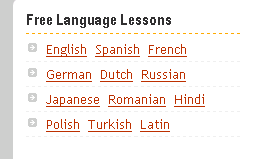
All you blogposts should contain links to your lessons. You can place them in the middle of you post like this: Spanish-English lessons. Or you can put them at the bottom of each of you posts just as a signature. When you get more familiar with the blogging process you can even modify the template for your blog. As an example you can see that this blog has links to different language lessons on the right side-bar. I mean these links:


Your articles shouldn't necessarily be in English - you can write in any language you want.

Other good things you can get from blogging:

  1. You become a better writer. It also means that if you learn English and write in English regularly your English improves, you style improves. And what happens when you have a better English? That't right - you get a better job! Or you get a promotion! You become more educated person! You pass your GRE, TOEFL, IELTS exams easier! You can continue counting the educational advantages of writing endlessly.
  2. Writing makes your thoughts more organized.
  3. You can earn money by blogging! Do you already have your Google AdSense account, has you public key been put on your InternetPolyglot lessons? They have started bringing you some money already - so make your blog bring you more money! Simply modify your blog's template and include the AdSense code on it (Blogger.com helps you to do it even without manually adjusting the template) and your blog will become your additional financial source.
  4. You still don't have AdSense account because when you tried to apply for it they asked you about what is your web site and you don't have one? Now that you've opened your blog and wrote 5-6 articles you can go ahead and apply for AdSense account again - you'll receive it very quickly (remember Blogger is owned by Google?). After that - you know what to do with it, don't you? :-) Right - after that you send me your AdSense public key so that I place it on your lessons and you place it on you blog and watch you account filling with money. So you blog will help you to get the AsSense account.
  5. Interestingly, it can be fun too. Yes, just writing can be pleasurable.

Don't forget to do a couple of things when you decide to open your blog:

  1. After you create your blog - write an email to me and I will add a link to your blog on my blog. This way it will be visible to people and search engines earlier.
  2. After you have 5-6 posts register on blogexplosion.com - for that click on this button on the right sidebar of my blog: - using it will help to drive more visitors on you blog and, therefore, to your lessons


I can't emphasize more the importance of blogging these days. Write regularly, about 250 words per post, preferably about learning of your language - and it will pay off very soon.

However, if you think that technical part of opening blog, modifying its template and so on is too dawnting for you and should prevent you from start writing articles - I will be willing to do it for you - you'll have to add me as a member of your blog and give me some privileges. When you are ready - just email me or IM me. Another possibility - I add you as a member of this blog and you start writing for it.

And don't forget: links, links, links! Remember to leave on the Internet as many links as you can. Links like that:
English-Spanish Lessons.

Promote your language lessons 3. Forums

To beginning Previous Article Next Article

Another great way to place many links pointing to your lessons is active participation in forums. Let me give you an example of what I do. Go to this link: one of the posts of InternetPolyglot on Unilang - you can see my post on the Unilang forum and if you scroll down to the end of my post you will see the links pointing to the lessons on InternetPolyglot:


You can do same thing! You can register in Unilang forum and become an active participant in its topics - you can participate in translations, language discussions and so on. The more active you are the more links to you lessons you'll place on this forum. Don't forget though to set these links in your profile.

But Unilang is not the only forum that talks about languages. You can find on the internet many forums where you could participate. Again, for example if you are creator of Spanish lessons you can participate in the following forums:

  1. Forums in English that talk about learning Spanish
  2. Forums in Spanish that talk about learning English, French, Russian, any other language
You might also have your own favorite forum where you go regularly. It can be not necessarily a language forum - it can be a forum about cooking, games, a local community forum. Simply add a link to you lessons to your signature and keep posting your thoughts - this is going to be enough.

There must be a word of caution though:
  1. Do not start blatantly advertising you lessons on the forums like this "Hey guys, look at these lessons - they are awesome!". Most forum moderators will kick you out of the forum without hesitation.
  2. Before you place the link to your lessons in your signature check if other people have links in their signatures. Simply look through several topics and see if other people have links in their signatures. If you see none it's better not try to be the first :-) you may well get kicked out by the moderator too.
As the bottom line for this method of promoting you language lessons: Forums seem to be the most natural and fun way of doing it - not only you attract more traffic to you lessons, you also have fun socializing with other people, expressing your thoughts.

To beginning Previous Article Next Article

Saturday, May 06, 2006

Promote your language lessons 2. Friends and Family.

To beginning Previous Article Next Article

Frends and Family.

To my experiense this is not a very effective way of promoting our site. Why? It seems to me that the main reason is that people who are close to us are statistically not in the process of language learning. Even if they are, they maybe at the stage when word memorizing is not an activity that they would like to do. And this is perfectly OK.

However, it still makes sense to send an email to your friends inviting them to visit your lessons (don't forget to provide the link to you lessons so that they don't spend too much time trying to find them). Also ask them what would be their recommendation on how to improve the site, its appearance, what other games they would be interested in playing, and so on. And don't forget to write me about their feedback or write about on the forum (http://www.internetpolyglot.com/phpBB2/index.php)!

To beginning Previous Article Next Article