One prominent Russian news site published an article about language learning (http://www.3dnews.ru/editorial/it_lingua/) - why, where, how and so on. I was amazingly impressed finding a good portion of it was about Internet Polyglot. So if you can read Russian - please visit this article http://www.3dnews.ru/editorial/it_lingua/ , scroll down about 2/3 of it and you'll see a review of Internet Polyglot that recommends using it for memorizing new words.
It might be a good chance that you came to Internet Polyglot from this article. Welcome and good luck in language learning with Internet Polyglot!
Tuesday, January 23, 2007


Internet Trips That Perfect Your Foreign Language
It has been stated on numerous occasions and in most specialty books and courses that the best way to learn and to build up on a foreign language is to live in an environment where this language is constantly present. The most obvious choice would be to visit or even move in a country that speaks that particular language but this often involves great costs and requires that you sacrifice a hefty amount of time for the trip (staying there for 2-3 days won't help too much, obviously). However, there is an alternative that can get you surrounded by the language you're learning without involving the costs and time requirements of actually visiting a foreign country: the so called "Internet Trips".
Internet trips will have you surfing the Internet for a learning location that is completely covered with the foreign language of choice. Using your favorite search engine, you could type in a common phrase in that language and click through the various sites resulted, in search of one that has some interesting information to read, view or listen to. If possible, try looking for a site that is completely built in that language, with as little English as possible. You need to feel "abroad" on this site, so it needs to be as foreign as possible in what regards its content.
Forums are also a great place to arrange an e-trip on. It doesn't really matter what the forum's subject is, as long as everyone or most of the participants in the discussions on are speakers of the language you're learning. Getting involved in the discussions, or even simply reading what others have to say about a subject will boost your vocabulary and general knowledge of that language. However, please note that it's a common fact for forum users to use slang, grammatically incorrect expressions or even common spelling mistakes.
The third option is to visit a "live chat" channel using one of the various programs designed for this purpose, or programs that offer live chat channels as an addition to their real purpose. Amongst such programs, we can include the IRC, DC and all of their variations. Visiting such channels gives you a chance to dynamically engage in conversations with native speakers of the language you're learning, but the same hindrance as in the above mentioned forum case remains: grammar and spelling are often sacrificed in favor of faster typing or simply commodity on these channels. Not to mention that sometimes the chat can get overly trivial for no reason, so you might be building on the wrong side of the vocabulary :).
This said, I wish you a safe journey. If you're after a more focused location for the language learning subject, you can skim through the numerous sites offering such services. If you find the language you're learning amongst those covered by these sites, try combining them with the above mentioned methods to get a better overall experience of your trip :).
Internet trips will have you surfing the Internet for a learning location that is completely covered with the foreign language of choice. Using your favorite search engine, you could type in a common phrase in that language and click through the various sites resulted, in search of one that has some interesting information to read, view or listen to. If possible, try looking for a site that is completely built in that language, with as little English as possible. You need to feel "abroad" on this site, so it needs to be as foreign as possible in what regards its content.
Forums are also a great place to arrange an e-trip on. It doesn't really matter what the forum's subject is, as long as everyone or most of the participants in the discussions on are speakers of the language you're learning. Getting involved in the discussions, or even simply reading what others have to say about a subject will boost your vocabulary and general knowledge of that language. However, please note that it's a common fact for forum users to use slang, grammatically incorrect expressions or even common spelling mistakes.
The third option is to visit a "live chat" channel using one of the various programs designed for this purpose, or programs that offer live chat channels as an addition to their real purpose. Amongst such programs, we can include the IRC, DC and all of their variations. Visiting such channels gives you a chance to dynamically engage in conversations with native speakers of the language you're learning, but the same hindrance as in the above mentioned forum case remains: grammar and spelling are often sacrificed in favor of faster typing or simply commodity on these channels. Not to mention that sometimes the chat can get overly trivial for no reason, so you might be building on the wrong side of the vocabulary :).
This said, I wish you a safe journey. If you're after a more focused location for the language learning subject, you can skim through the numerous sites offering such services. If you find the language you're learning amongst those covered by these sites, try combining them with the above mentioned methods to get a better overall experience of your trip :).
Tuesday, January 16, 2007
Russian Lessons in Audio [New Feature]
Do you learn Russian? If yes, this new feature is for you! Go to this lesson: http://www.internetpolyglot.com/lesson-4302101130 and you'll see a "Play" button next to each Russian phrase.

Press this button and you'll hear the pronunciation of this phrase. You'll need to have your earphones speakers on of course. More Russian lessons can be found here: Free Russian Lessons Online. All of them now have their words pronounced.
Please also visit our articles about Russian in different languages: The Russian Language (in English); Lengua Rusa (in Spanish); Langue russe (in French); Russische Sprache (in German); Lingua russa (in Italian); Russische Taal (in Dutch); Língua Russian (in Portuguese); Limba Rusa (in Romanian)
Also there is a large collection of articles about different languages written in Russian:
История английского языка
Корни испанского языка
Три причины, чтобы начать учить французский
О китайском языке
Что хорошо было бы знать о немецком языке
Язык Восходящего Солнца
Сведения об итальянском языке
Голландский язык – от истоков до наших дней
Выучить русский – «зачем» и «как»
Краткий обзор истории португальского языка
Краткие сведения об арабском языке
Полезные советы изучающим иврит
Истоки цивилизации
Хинди. История и факты
Корни польского языка
История румынского языка
Турецкий язык. Исторические факты
Происхождение и история чешского языка
Корни украинского языка
Friday, January 12, 2007
New Language Lessons: Hebrew
New language lessons have been uploaded today to the Internet Polyglot site. This time the new addition is Hebrew lessons. So if you are interested in learning this ancient language, please be very welcome to http://www.internetpolyglot.com/lessons-he-en .
History of the Hebrew Language
Hebrew is one of the world oldest languages and it’s one of the few languages that kept its composure and structure for the most part, since it is written and spoken today almost the same way as it was more than 2,000 years ago. For example, the style and structure of the Hebrew language that is used today in most books, newspapers and magazines published in Israel is very similar to the one used in the Bible. A strange fact in the history of the Hebrew language is that it ceased to exist as a spoken language for almost 1,700 years ago, being reborn as a modern language around the 19th century. Nowadays, Hebrew is the official language of Israel and it is spoken in the large Jewish Diaspora.
The comeback of Hebrew as a spoken language in the 19th century is often attributed to the name of Eliezer ben Yehudah. Eliezer was a visionary linguist and polyglot that devoted his entire life to the revival of his ancestors’ language, adapting it to the rigors and rules of modern society as well as allowing a substantial vocabulary increase through foreign words. Following Eliezer’s efforts, Hebrew gradually came to use among Jewish settlements around Palestine and when the State of Israel was created in 1948 it became its official language.
Tips and tricks for learning Hebrew
One of the fastest ways to learn Hebrew is over the Internet (for example, on Internet Polyglot Hebrew Lessons), where you can find a lot of free Hebrew lessons online to start off with. If these don’t cut the mustard for you, you could always try a local “Learn Hebrew” course or start studying it from a course book. However, these methods should only be considered a starting point to help you grasp the basic notions of Hebrew and help you improve vocabulary. Direct communication is always a great teacher, so you can try finding a Hebrew conversation partner to help you out, or even try out learning through video conferences with an online teacher (they could cost quite a bit though).
The grammar of the Hebrew language is usually considered easy to understand by most students, however the major problem is spelling and pronunciation of words. These can be improved through several of the above mentioned methods, but if you find those too boring or stressful, you might want to try out a few Hebrew vocabulary games that you can find in books, on audio tapes or over the Internet. These games improve both spelling and pronunciations and they will also allow you to memorize words easily.
Take note that these tips and tricks don’t apply STRICTLY to Hebrew, as they can be used in studying a number of other languages. Remember that learning skills grow up directly proportional with language skills, so the more you learn of a language the better you are at learning a different one in the future. Once this happens, becoming a true polyglot is only a matter of time and ambition.
You can also read about Hebrew in these articles in different languages:
History of the Hebrew Language (in English)
Lengua hebrea (in Spanish)
Hébreu (in French)
Hebräisch (in German)
Ebraico (in Italian)
Hebreeuws (in Dutch)
Hebrew (in Portuguese)
Limba Ebraica (in Romanian)
Полезные советы изучающим иврит (in Russian)
تأريخ اللغة العبرية (in Arabic)
History of the Hebrew Language
Hebrew is one of the world oldest languages and it’s one of the few languages that kept its composure and structure for the most part, since it is written and spoken today almost the same way as it was more than 2,000 years ago. For example, the style and structure of the Hebrew language that is used today in most books, newspapers and magazines published in Israel is very similar to the one used in the Bible. A strange fact in the history of the Hebrew language is that it ceased to exist as a spoken language for almost 1,700 years ago, being reborn as a modern language around the 19th century. Nowadays, Hebrew is the official language of Israel and it is spoken in the large Jewish Diaspora.
The comeback of Hebrew as a spoken language in the 19th century is often attributed to the name of Eliezer ben Yehudah. Eliezer was a visionary linguist and polyglot that devoted his entire life to the revival of his ancestors’ language, adapting it to the rigors and rules of modern society as well as allowing a substantial vocabulary increase through foreign words. Following Eliezer’s efforts, Hebrew gradually came to use among Jewish settlements around Palestine and when the State of Israel was created in 1948 it became its official language.
Tips and tricks for learning Hebrew
One of the fastest ways to learn Hebrew is over the Internet (for example, on Internet Polyglot Hebrew Lessons), where you can find a lot of free Hebrew lessons online to start off with. If these don’t cut the mustard for you, you could always try a local “Learn Hebrew” course or start studying it from a course book. However, these methods should only be considered a starting point to help you grasp the basic notions of Hebrew and help you improve vocabulary. Direct communication is always a great teacher, so you can try finding a Hebrew conversation partner to help you out, or even try out learning through video conferences with an online teacher (they could cost quite a bit though).
The grammar of the Hebrew language is usually considered easy to understand by most students, however the major problem is spelling and pronunciation of words. These can be improved through several of the above mentioned methods, but if you find those too boring or stressful, you might want to try out a few Hebrew vocabulary games that you can find in books, on audio tapes or over the Internet. These games improve both spelling and pronunciations and they will also allow you to memorize words easily.
Take note that these tips and tricks don’t apply STRICTLY to Hebrew, as they can be used in studying a number of other languages. Remember that learning skills grow up directly proportional with language skills, so the more you learn of a language the better you are at learning a different one in the future. Once this happens, becoming a true polyglot is only a matter of time and ambition.
You can also read about Hebrew in these articles in different languages:
History of the Hebrew Language (in English)
Lengua hebrea (in Spanish)
Hébreu (in French)
Hebräisch (in German)
Ebraico (in Italian)
Hebreeuws (in Dutch)
Hebrew (in Portuguese)
Limba Ebraica (in Romanian)
Полезные советы изучающим иврит (in Russian)
تأريخ اللغة العبرية (in Arabic)
Learning A New Language To Create A Bilingual Household
Learning a new language as a family can be a wonderful and rewarding thing to do, especially if you have small children at home. For them, learning at smaller ages will be much easier than learning later in life. It will also be more rewarding for you, as a family to be able to have that extra cultural exposure that another language makes available to you. Most children will grow up learning both languages naturally, at the same time if they are used constantly near him. However, if you want to speed up the process or make it more effective, there are several techniques that you can try out.
For example, there are many online programs that can assist you with learning a new language for yourself as well as making the process fun through the use of games for the entire family. In addition to the ability or need to memorize words, you will find that these online programs will actually teach you to analyze and choose the correct words in the first place. This is done through the use of flash cards, matching games, word scrambles, and tons of other games that make the learning process seem much less like learning and much more like fun.
If you are having fun learning something, chances are that your children will wish to learn as well. Keep reminding them how fun it will be to travel to the land of the language and speak like a native or go out to dinner in a new town and pretend to be foreign by only speaking to each other in the language you've learned. Not to mention the fun they will have on the school bus when no one else really understands what they are saying.
Raising a bilingual family in today's world has many benefits that go far beyond knowing a second language. In addition to the languages learned you are increasing their ability to learn more languages, as each subsequent language is easier to learn. While at a young age, children may have a tendency to mix languages or switch back and forth that is something that will occur less frequently in time.
The process of creating a bilingual household also requires a considerable amount more effort on the part of the parents. Not only are you learning a new language and committing to learning it well enough to teach to your children and speak on a regular basis, but you are also committing your child to another language as well. This can be confusing to him or her at times and overwhelming at others. Be careful that you don't overload them, which may cause them to stop speaking all together and that you are patient with them offering support and kind words when needed. This is one of the greatest gifts you can give your children and they will understand that in time.
For example, there are many online programs that can assist you with learning a new language for yourself as well as making the process fun through the use of games for the entire family. In addition to the ability or need to memorize words, you will find that these online programs will actually teach you to analyze and choose the correct words in the first place. This is done through the use of flash cards, matching games, word scrambles, and tons of other games that make the learning process seem much less like learning and much more like fun.
If you are having fun learning something, chances are that your children will wish to learn as well. Keep reminding them how fun it will be to travel to the land of the language and speak like a native or go out to dinner in a new town and pretend to be foreign by only speaking to each other in the language you've learned. Not to mention the fun they will have on the school bus when no one else really understands what they are saying.
Raising a bilingual family in today's world has many benefits that go far beyond knowing a second language. In addition to the languages learned you are increasing their ability to learn more languages, as each subsequent language is easier to learn. While at a young age, children may have a tendency to mix languages or switch back and forth that is something that will occur less frequently in time.
The process of creating a bilingual household also requires a considerable amount more effort on the part of the parents. Not only are you learning a new language and committing to learning it well enough to teach to your children and speak on a regular basis, but you are also committing your child to another language as well. This can be confusing to him or her at times and overwhelming at others. Be careful that you don't overload them, which may cause them to stop speaking all together and that you are patient with them offering support and kind words when needed. This is one of the greatest gifts you can give your children and they will understand that in time.
Friday, December 22, 2006
Happy Holidays!
Hi everybody!
I'd like to thank you all for showing your support for Internet Polyglot, for using it for your language learning and just for your many feedbacks. It was very exciting year for us and for the site - it grew from 15 visitors a day to 1100 visitors a day and keep growing. More and more language learners find this method of memorizing words useful and start playing with our games.
I would cordially like to wish you happy Holidays, peace in the whole World, love to you and your family. And of course, Happy Language Learning with Internet Polyglot!
Now it's time for some fun. These videos virtually made my month! They can be even considered a language learning videos, hehe :)
Let's start with Learning Dutch. Hilarious girls teach us some useful Dutch words and phrases: http://www.youtube.com/watch?v=jGzwZH03QLE
Learning French? Here some funny guys from Russia will sing you a very popular song by one of my favorite singers In-Grid: http://www.youtube.com/watch?v=CGJRTpgE0dY
And here is the transcript for this song:
Tu m'as promis
et je t'ai cru
Tu m'as promis le soleil en hiver et un arc en ciel
tu m'as promis le sable doré j'ai reçu une carte postale
tu m'as promis le ciel et la terre et une vie d'amour
tu m'as promis ton coeur ton sourire mais j'ai eu des grimaces
tu m'as promis
et je t'ai cru
tu m'as promis le cheval ailé que j'ai jamais eu
tu m'as promis le fil d'Ariane mais tu l'as coupé
tu m'as promis les notes de Mozart pas des plats cassés
tu m'as promis d'être ta reine, j'ai eu pour sceptre un balai
tu m'as promis
et je t'ai cru
tu es foutu
tu-tu-tu...
tu es foutu
tu-tu-tu ...
je ne sais pas ce qui se passe
mais je sais pourquoi on m'apelle mademoiselle pas de chance
Learning English, huh? Yeah, me too :) Have been learning English for almost all my conscious life, hehe. Here is a fiery Irish song: http://www.youtube.com/watch?v=I6A-ucLv44Y
And finally, here is a Holiday song for all of you: http://www.youtube.com/watch?v=owK5tHjL0aE
Happy Holidays!!!
I'd like to thank you all for showing your support for Internet Polyglot, for using it for your language learning and just for your many feedbacks. It was very exciting year for us and for the site - it grew from 15 visitors a day to 1100 visitors a day and keep growing. More and more language learners find this method of memorizing words useful and start playing with our games.
I would cordially like to wish you happy Holidays, peace in the whole World, love to you and your family. And of course, Happy Language Learning with Internet Polyglot!
Now it's time for some fun. These videos virtually made my month! They can be even considered a language learning videos, hehe :)
Let's start with Learning Dutch. Hilarious girls teach us some useful Dutch words and phrases: http://www.youtube.com/watch?v=jGzwZH03QLE
Learning French? Here some funny guys from Russia will sing you a very popular song by one of my favorite singers In-Grid: http://www.youtube.com/watch?v=CGJRTpgE0dY
And here is the transcript for this song:
Tu m'as promis
et je t'ai cru
Tu m'as promis le soleil en hiver et un arc en ciel
tu m'as promis le sable doré j'ai reçu une carte postale
tu m'as promis le ciel et la terre et une vie d'amour
tu m'as promis ton coeur ton sourire mais j'ai eu des grimaces
tu m'as promis
et je t'ai cru
tu m'as promis le cheval ailé que j'ai jamais eu
tu m'as promis le fil d'Ariane mais tu l'as coupé
tu m'as promis les notes de Mozart pas des plats cassés
tu m'as promis d'être ta reine, j'ai eu pour sceptre un balai
tu m'as promis
et je t'ai cru
tu es foutu
tu-tu-tu...
tu es foutu
tu-tu-tu ...
je ne sais pas ce qui se passe
mais je sais pourquoi on m'apelle mademoiselle pas de chance
Learning English, huh? Yeah, me too :) Have been learning English for almost all my conscious life, hehe. Here is a fiery Irish song: http://www.youtube.com/watch?v=I6A-ucLv44Y
And finally, here is a Holiday song for all of you: http://www.youtube.com/watch?v=owK5tHjL0aE
Happy Holidays!!!
Wednesday, November 22, 2006
World Map of Internet Polyglot users
I have configured a world map of Internet Polyglot users. Now if you are an Internet Polyglot user, you play with its games, learn languages using its lessons, you can add yourself on the world map (if you don't see the map, go here):
This page is also added on Internet Polyglot here. The permanent location of this map is here. When you go to this map you can add your shoutouts, your pictures, chat with other Internet Polyglot users. Have fun!
This page is also added on Internet Polyglot here. The permanent location of this map is here. When you go to this map you can add your shoutouts, your pictures, chat with other Internet Polyglot users. Have fun!
Monday, November 20, 2006
Learning A New Language Makes The World Seem Smaller
The Internet is becoming a massive force in the lives of many people around the world. It is used to connect to the world at large, to communicate for the purposes of business, family, and friendships, as well as to find entertainment. The Internet is quickly replacing the television as the preferred medium of entertainment around the world as well as opening doors to new cultures, ideas, and beliefs as well as new opportunities.
As a result of this, we've seen an abundance of people interested in learning new languages as they meet friends and build relationships across the cultural and language barriers that once seemed so much larger than they are today. With the global community literally at your fingertips it is great to know that you can get free language lessons online or that you can easily find courses and books to help you skill up in a foreign language, regardless of its popularity across the Globe. You'd be amazed to find out how many sites offer such great services for free. Not only are these lessons free, but you can also find programs that offer fun matching games, flash cards, and word game worksheets to help you build your skills.
Not only will you learn the basic vocabulary of other languages, but also how to improve your existing vocabulary skills in your own language. You will study language arts activities, pronouns, adjectives, and common slang terms of the language you are studying. You will be able to travel with the ease of a native without the worry of needing translations of road signs and simple instructions thanks to flash cards, and free language lessons online.
When used alone, the results of this will be slow and not provide a comprehensive learning experience, but when you combine the power of such an interactive site with your other language courses, you will be amazed at how quickly your progress and even advance in your studies. Play games designed to improve vocabulary while receiving a top-notch foreign language education. In fact, you have the ability to teach yourself at your own pace and learn far more than you would ever learn in a traditional classroom. It is well known that learning through entertainment is the easiest and most effective way of dealing with any given subject, even more so with a foreign language, since it requires a lot of assimilation to be done.
After completing your lessons you should be able to speak your new language like a native while having a better understanding of how your own language works. Perhaps what you learn about yourself and the language you know already is worth just as much if not more than the priceless gift of learning a new language and opening a window to the world.
Articles about English in different languages:
English Language (in English)
Historia de la lengua inglesa (in Spanish)
Anglais. (in French)
Englische Sprache (in German)
Lingua inglese (in Italian)
Engelse Taal (in Dutch)
Língua inglesa (in Portuguese)
Limba Engleza (in Romanian)
As a result of this, we've seen an abundance of people interested in learning new languages as they meet friends and build relationships across the cultural and language barriers that once seemed so much larger than they are today. With the global community literally at your fingertips it is great to know that you can get free language lessons online or that you can easily find courses and books to help you skill up in a foreign language, regardless of its popularity across the Globe. You'd be amazed to find out how many sites offer such great services for free. Not only are these lessons free, but you can also find programs that offer fun matching games, flash cards, and word game worksheets to help you build your skills.
Not only will you learn the basic vocabulary of other languages, but also how to improve your existing vocabulary skills in your own language. You will study language arts activities, pronouns, adjectives, and common slang terms of the language you are studying. You will be able to travel with the ease of a native without the worry of needing translations of road signs and simple instructions thanks to flash cards, and free language lessons online.
When used alone, the results of this will be slow and not provide a comprehensive learning experience, but when you combine the power of such an interactive site with your other language courses, you will be amazed at how quickly your progress and even advance in your studies. Play games designed to improve vocabulary while receiving a top-notch foreign language education. In fact, you have the ability to teach yourself at your own pace and learn far more than you would ever learn in a traditional classroom. It is well known that learning through entertainment is the easiest and most effective way of dealing with any given subject, even more so with a foreign language, since it requires a lot of assimilation to be done.
After completing your lessons you should be able to speak your new language like a native while having a better understanding of how your own language works. Perhaps what you learn about yourself and the language you know already is worth just as much if not more than the priceless gift of learning a new language and opening a window to the world.
Articles about English in different languages:
English Language (in English)
Historia de la lengua inglesa (in Spanish)
Anglais. (in French)
Englische Sprache (in German)
Lingua inglese (in Italian)
Engelse Taal (in Dutch)
Língua inglesa (in Portuguese)
Limba Engleza (in Romanian)
Tuesday, November 14, 2006
Do you like Internet Polyglot? Then vote for it!
My dear language learning friend! You've been working hard on learning your language and I hope Internet Polyglot has been helpful for you all this time. If you like Internet Polyglot now you can help us too!
Here is what you can do: just click on the following link and vote for Internet Polyglot by Digging it!
Please note that if you don't have an account on Digg you'll have to register there in order to vote for Internet Polyglot.
We'll greatly appreciate your vote, it'll help us immensely to improve Internet Polyglot's visibility in language learning community. Thank you!
And to make your life funnier here is the daily joke:
Speed Trap
A state trooper spied a car puttering along at 22 MPH. So he turned on his lights and pulled the driver over. Approaching the car, he noticed that five old guys were inside, and they looked wide-eyed and terribly pale.
The driver pleaded with him, "Officer, I don't understand, I was doing exactly the speed limit! What seems to be the problem?"
"Sir," the officer replies, "You weren't speeding, but driving slower than the speed limit can also be dangerous."
"I beg to differ, Officer, I was doing the speed limit exactly: twenty-two miles an hour!" the old man said.
The trooper, chuckling, explained to him that "22" was the route number, not the speed limit. A bit embarrassed, the man grinned and thanked the officer for pointing out his error.
"But before I let you go, Sir, I have to ask... Is everyone in this car ok? These guys seem awfully shaken."
"Oh, they'll be all right in a minute," the old man said. "We just got off Route 119."
Enjoy your day folks and don't forget to vote for Internet Polyglot and after that visit Internet Polyglot for language lessons!
Here is what you can do: just click on the following link and vote for Internet Polyglot by Digging it!
Please note that if you don't have an account on Digg you'll have to register there in order to vote for Internet Polyglot.
We'll greatly appreciate your vote, it'll help us immensely to improve Internet Polyglot's visibility in language learning community. Thank you!
And to make your life funnier here is the daily joke:
Speed Trap
A state trooper spied a car puttering along at 22 MPH. So he turned on his lights and pulled the driver over. Approaching the car, he noticed that five old guys were inside, and they looked wide-eyed and terribly pale.
The driver pleaded with him, "Officer, I don't understand, I was doing exactly the speed limit! What seems to be the problem?"
"Sir," the officer replies, "You weren't speeding, but driving slower than the speed limit can also be dangerous."
"I beg to differ, Officer, I was doing the speed limit exactly: twenty-two miles an hour!" the old man said.
The trooper, chuckling, explained to him that "22" was the route number, not the speed limit. A bit embarrassed, the man grinned and thanked the officer for pointing out his error.
"But before I let you go, Sir, I have to ask... Is everyone in this car ok? These guys seem awfully shaken."
"Oh, they'll be all right in a minute," the old man said. "We just got off Route 119."
Enjoy your day folks and don't forget to vote for Internet Polyglot and after that visit Internet Polyglot for language lessons!
Friday, November 10, 2006
Google Helps Learning Words [New Feature]
Today I deployed a new version of http://www.InternetPolyglot.com - it has some nice improvements like better positioning of popup images so that they don't disappear under the bottom of the browser window.
Another one is a new page that describes how you could help Internet Polyglot - if you like it, of course :-) . So if you do like Internet Polyglot - please visit this page: http://www.internetpolyglot.com/public-helping-internet-polyglot.html and decide what you can do to make our life happier. Anything you do from this list (placing a link on your web site, telling about us on your favorite forum or newsgroup, simply bookmarking us with del.icio.us, and, well, ghm..., donation) will be greatly appreciated!
But the main improvement of this version is adding Google Search capabilities for words that you are learning. The word/translation list on lesson detail pages now has a new icon, move your mouse over it and you'll get Google's search results for this word: web sites, videos, blogs. I expect it to be a very useful new feature of Internet Polyglot - it should help learning words in context. Just go ahead and play with this new capability, I think it should be fun.
Below is a screenshot that I made on one of the French-English lessons :
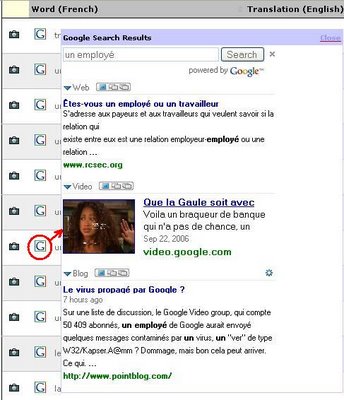
As you can see mousing over the "G" icon next to "un employé" display a popup window with Google search (web, video and blog) results for this word. Now just use any of those results and increase your knowledge of what "un employé" means.
Happy languge learning with Internet Polyglot !
Another one is a new page that describes how you could help Internet Polyglot - if you like it, of course :-) . So if you do like Internet Polyglot - please visit this page: http://www.internetpolyglot.com/public-helping-internet-polyglot.html and decide what you can do to make our life happier. Anything you do from this list (placing a link on your web site, telling about us on your favorite forum or newsgroup, simply bookmarking us with del.icio.us, and, well, ghm..., donation) will be greatly appreciated!
But the main improvement of this version is adding Google Search capabilities for words that you are learning. The word/translation list on lesson detail pages now has a new icon, move your mouse over it and you'll get Google's search results for this word: web sites, videos, blogs. I expect it to be a very useful new feature of Internet Polyglot - it should help learning words in context. Just go ahead and play with this new capability, I think it should be fun.
Below is a screenshot that I made on one of the French-English lessons :
As you can see mousing over the "G" icon next to "un employé" display a popup window with Google search (web, video and blog) results for this word. Now just use any of those results and increase your knowledge of what "un employé" means.
Happy languge learning with Internet Polyglot !
Subscribe to:
Posts (Atom)


