Learning a new language is never easy, despite any common roots that your mother tongue and the language you want to learn might have. If you've recently moved to a new country, the learning curve will be a lot faster than if you would try to learn that particular country's language at home, since no lesson can compensate for the benefit of being constantly surrounded in people speaking that foreign language. Still, since most people will want to start taking language lessons from the comfort of their home, so they can be prepared when they move or visit a foreign country, we'll focus on them and offer you some tips on how to get free language lessons online.
Whether you want to learn English, Spanish, French, German, Japanese, Italian, Dutch, Russian, Portuguese, Arabic, Latin, Hindi, Polish, Romanian, Turkish, Czech or Ukrainian, there's a site out there that can fulfill your lingual learning needs. www.internetpolyglot.com is a compilation of free language lessons that can be taken online, through an intuitive and easy to use system.
Actually, when learning a new language with Internet Polyglot, you get to create your own lessons, focusing on what you need more: expanding your vocabulary, memorizing words, pronouncing words, learning the common acronyms of communication, avoiding syntax errors in second language learners, learning that particular language's slang and so forth. This way, you can make up your own strategy for learning a foreign language and effectively learn in the rhythm that you see fit, instead of getting overfed with all sorts of bits and pieces of new information about that language.
Among these free online language lessons, you will be able to find some that come under the form of games and fun activities. These are aimed for children learning new languages but they can also be helpful to adults that have just started learning one. Actually, scientists agree that it's a lot easier to learn a language if its lessons are presented under a fun, enjoyable wrap, rather than if you would have to sit down at a table or in front of your PC and simply start memorizing, getting you utterly bored in a matter of hours probably.
Last but not least, www.internetpolyglot.com offers the possibility for simple surfers that had success in learning a new language, to post their own lessons on the site, helping others in their learning process. Of course, what might have worked for someone else in matter of learning speed might not be totally appropriate for you, or at least not in the same manner. But most of these users will offer interesting alternative learning methods that you should at least take a look at, since they might prove to be just the boost you need to your language learning efforts.
Visit http://www.InternetPolyglot.com for free online language lessons.
Thursday, November 09, 2006


Monday, November 06, 2006
Drunk Driver
Aren't you getting fed up with all this serious stuff that you receive from InternetPolyglot on a regular basis? Here is some joke for you so that you don't get too bored :)
A policeman pulls over a driver for swerving in and out of lanes on the highway.
He tells the guy to blow a breath into a breathalyzer.
''I can't do that, officer.''
''Why not?''
''Because I'm an asthmatic. I could get an asthma attack if I blow into that tube.''
''Okay, we'll just get a urine sample down at the station.''
''Can't do that either, officer.''
''Why not?''
''Because I'm a diabetic. I could get low blood sugar if I pee in a cup.''
''Alright, we could get a blood sample.''
''Can't do that either, officer.''
''Why not?''
''Because I'm a hemophiliac. If I give blood I could die.''
''Fine then, just walk this white line.''
''Can't do that either, officer.''
''Why not?''
''Because I'm drunk.''
A policeman pulls over a driver for swerving in and out of lanes on the highway.
He tells the guy to blow a breath into a breathalyzer.
''I can't do that, officer.''
''Why not?''
''Because I'm an asthmatic. I could get an asthma attack if I blow into that tube.''
''Okay, we'll just get a urine sample down at the station.''
''Can't do that either, officer.''
''Why not?''
''Because I'm a diabetic. I could get low blood sugar if I pee in a cup.''
''Alright, we could get a blood sample.''
''Can't do that either, officer.''
''Why not?''
''Because I'm a hemophiliac. If I give blood I could die.''
''Fine then, just walk this white line.''
''Can't do that either, officer.''
''Why not?''
''Because I'm drunk.''
Learning A Foreign Language Will Open A Window To The World
If you've ever had the urge to travel around the world, visiting exotic places, and ordering authentic local cuisine, then you've probably considered the fact that it might help if you were able to speak the language. Even if only to read the menu at your favorite French Bistro or Italian Restaurant, it is amazing how much more of the menu you will understand simply by learning a few key phrases in a foreign language.
Learning a new language is almost always a thrilling prospect, even better when you can learn a new language for free. In fact, at this price why on earth would anyone stop at just one language? Many of these online language programs are not intended to work as a sole source of language education, but when used in conjunction with other language learning programs can produce amazing results.
If you use the flash cards and matching games that are available on this site, you will be speaking your new language like a native in no time, better yet, you will understand it like a native as well. Have you ever envied those that speak several languages with as much familiarity as their own mother tongues? Be jealous no longer. Apply these lessons, study diligently and you will notice a significant improvement in your vocabulary.
Learn an Arabic language conversation free with lessons online. In fact, learn a few. Take a look at the free online "Learn Spanish Video" and see how many new words you can learn in a short period of time. Take lessons with a friend and have competitions to see who has learned the most new words. Playing games is a great way to learn and still have fun being competitive with one another.
Remember though that the overall goal is learning a new language. Whether your goals are Russian, Hungarian, English, French, or some obscure tribal language on the moon, you might be surprised at the selection available. You can even use this program to help you avoid the syntax errors in English second language learners. This will make an incredible difference in how you are accepted globally as well as corporately.
There are several sites out there that deal with teaching a foreign language and you're bound to find something suitable for your needs even after a few minutes of electronic surfing. Although most will focus on popular languages such as English, French, German, Spanish, Russian, Italian or Portuguese, other "smaller" languages are not left out in the cold either. Regardless of what language you're aiming for, chances are that you can find a site that covers it and offers some learning courses for it.
For free online language courses visit http://www.InternetPolyglot.com
Articles about Spanish in different languages:
The Spanish Language (in English)
Las raíces de la lengua española (in Spanish)
Langue espagnole (in French)
Spanische Sprache (in German)
Lingua spagnola (in Italian)
Spaanse Taal (in Dutch)
Língua espanhola (in Portuguese)
Originile limbii Spaniole (in Romanian)
Learning a new language is almost always a thrilling prospect, even better when you can learn a new language for free. In fact, at this price why on earth would anyone stop at just one language? Many of these online language programs are not intended to work as a sole source of language education, but when used in conjunction with other language learning programs can produce amazing results.
If you use the flash cards and matching games that are available on this site, you will be speaking your new language like a native in no time, better yet, you will understand it like a native as well. Have you ever envied those that speak several languages with as much familiarity as their own mother tongues? Be jealous no longer. Apply these lessons, study diligently and you will notice a significant improvement in your vocabulary.
Learn an Arabic language conversation free with lessons online. In fact, learn a few. Take a look at the free online "Learn Spanish Video" and see how many new words you can learn in a short period of time. Take lessons with a friend and have competitions to see who has learned the most new words. Playing games is a great way to learn and still have fun being competitive with one another.
Remember though that the overall goal is learning a new language. Whether your goals are Russian, Hungarian, English, French, or some obscure tribal language on the moon, you might be surprised at the selection available. You can even use this program to help you avoid the syntax errors in English second language learners. This will make an incredible difference in how you are accepted globally as well as corporately.
There are several sites out there that deal with teaching a foreign language and you're bound to find something suitable for your needs even after a few minutes of electronic surfing. Although most will focus on popular languages such as English, French, German, Spanish, Russian, Italian or Portuguese, other "smaller" languages are not left out in the cold either. Regardless of what language you're aiming for, chances are that you can find a site that covers it and offers some learning courses for it.
For free online language courses visit http://www.InternetPolyglot.com
Articles about Spanish in different languages:
The Spanish Language (in English)
Las raíces de la lengua española (in Spanish)
Langue espagnole (in French)
Spanische Sprache (in German)
Lingua spagnola (in Italian)
Spaanse Taal (in Dutch)
Língua espanhola (in Portuguese)
Originile limbii Spaniole (in Romanian)
Monday, October 30, 2006
Language Learning Key In Higher Education
Learning a new language can be frightening, exciting, fun, and unfortunately sometimes boring. Taking free language lessons makes the boring part of that equation obsolete by using games, flash cards, and word scrambles in order to help you memorize words and learn vocabulary. It's not that hard to prove that if you're learning something by having fun, you will assimilate a lot more information (in this case grammar, spelling, vocabulary, etc) than if you would simply learn it "the hard way".
Having fun while learning is a great way to build your marketability, not only in the career world but also the collegiate world. You will qualify for far more study abroad programs if you can speak the language of the land you will be visiting for a semester or summer term of your educational experience. Taking free language lessons online through many of the great language learning programs available can also help you brush up on your vocabulary and memorize words by having you play educational games and use flashcards. This is better than taking a new course in a language simply to improve your existing skills or walking around with a dictionary handy at all times.
In addition to study abroad programs, language skills are necessary for entrance into many graduate school programs. Some programs, even require fluency in not one, but two foreign languages. The good news is that once you've learned one new language, learning another language is easier. If the two languages share a common lexical foundation (such as Slavic, Latin, Anglo-Saxon languages) then it will be even easier to "jump" from one of them to the other. The even better news is that with these free online programs you can learn as many new languages as you would like.
If you are planning to take your LSAT online, free practice tests can be found here as well as. You can also find bilingual legal dictionaries on CD format if you know where to look. This will help those who are learning English as a second language and hope to attend law school as well as those who simply need to learn American laws for the sake of legal work they are doing in other countries.
For the sake of education, learning a foreign language is becoming less of an option and more of a requirement. In addition to learning about other languages and cultures during the course of studying new languages, you also learn a great deal more about your own language and culture as well as how the world views you, often by default. There are very few things you can learn that will have as great of an impact on your life as a new language.
For free online language lessons visit http://www.InternetPolyglot.com
Articles about French in different languages:
The French Language (in English)
La Lengua Francesa (in Spanish)
Langue française. (in French)
Französische Sprache (in German)
Lingua francese (in Italian)
Franse Taal (in Dutch)
Língua francesa (in Portuguese)
Limba Franceza (in Romanian)
Having fun while learning is a great way to build your marketability, not only in the career world but also the collegiate world. You will qualify for far more study abroad programs if you can speak the language of the land you will be visiting for a semester or summer term of your educational experience. Taking free language lessons online through many of the great language learning programs available can also help you brush up on your vocabulary and memorize words by having you play educational games and use flashcards. This is better than taking a new course in a language simply to improve your existing skills or walking around with a dictionary handy at all times.
In addition to study abroad programs, language skills are necessary for entrance into many graduate school programs. Some programs, even require fluency in not one, but two foreign languages. The good news is that once you've learned one new language, learning another language is easier. If the two languages share a common lexical foundation (such as Slavic, Latin, Anglo-Saxon languages) then it will be even easier to "jump" from one of them to the other. The even better news is that with these free online programs you can learn as many new languages as you would like.
If you are planning to take your LSAT online, free practice tests can be found here as well as. You can also find bilingual legal dictionaries on CD format if you know where to look. This will help those who are learning English as a second language and hope to attend law school as well as those who simply need to learn American laws for the sake of legal work they are doing in other countries.
For the sake of education, learning a foreign language is becoming less of an option and more of a requirement. In addition to learning about other languages and cultures during the course of studying new languages, you also learn a great deal more about your own language and culture as well as how the world views you, often by default. There are very few things you can learn that will have as great of an impact on your life as a new language.
For free online language lessons visit http://www.InternetPolyglot.com
Articles about French in different languages:
The French Language (in English)
La Lengua Francesa (in Spanish)
Langue française. (in French)
Französische Sprache (in German)
Lingua francese (in Italian)
Franse Taal (in Dutch)
Língua francesa (in Portuguese)
Limba Franceza (in Romanian)
Thursday, October 26, 2006
Building Up Your Vocabulary In A Foreign Language
You can't say you have a solid grasp on a foreign language unless you have a solid vocabulary to back your claims up. Grammar, spelling and pronunciation mistakes might slip every once in a while, but if you're reading a text or listening to a conversation and can't understand a third of the words used there, what's the point? There are several techniques that are used in building up your vocabulary in a foreign language and we'll try to cover some of the most common, which you can practice without spending too much or looking too far for them.
Reading new texts and their translation
A lot of language learning books rely on this technique to get the student's vocabulary up and running from the first lessons. The students are given a rough text in the foreign language (the difficulty level of the test is dependant on the level the student is considered to having reached so far) containing some new, more complex words with each sentence. Below the text, an exact translation is given, with contextual annotations if it's the case. After the translation, the words that are being considered as "new" are usually given a definition of and if they are used in a specific context in the above mentioned text, this is also mentioned.
Picking words out of the context
Oftentimes, you'll be reading a text or listening to someone speak in a foreign language that you know and spot a word that you don't understand. Focusing on the context in which it is told however, will often give you a clue about what it means. If this doesn't happen and you're totally in the dark about what that particular word means (oftentimes convoluting the entire context too) you can look it up in a dictionary.
Visiting the native speakers
Nothing will boost your vocabulary faster and better than a visit to a native speaking country of the particular language you want to expand in. Even a one-week trip will teach you more new words than an entire course in that language, not to mention spending a few months out there with the natives. This obviously perfects your grammar, spelling and pronunciation of words together with your vocabulary, which can only be beneficial. The only problem might be the costs such a trip would take and the amount of free time you will need for it.
This said, feel free to skim the Internet for any sources that can help you expand your vocabulary in a particular foreign language. After all, you can't simply take the dictionary and start learning new words by heart; you need to learn them naturally, out of their context. Even if you learn one new word per day this way, in the long run you'll surely feel the difference.
For building your foreign language vocabulary visit http://www.InternetPolyglot.com.
Reading new texts and their translation
A lot of language learning books rely on this technique to get the student's vocabulary up and running from the first lessons. The students are given a rough text in the foreign language (the difficulty level of the test is dependant on the level the student is considered to having reached so far) containing some new, more complex words with each sentence. Below the text, an exact translation is given, with contextual annotations if it's the case. After the translation, the words that are being considered as "new" are usually given a definition of and if they are used in a specific context in the above mentioned text, this is also mentioned.
Picking words out of the context
Oftentimes, you'll be reading a text or listening to someone speak in a foreign language that you know and spot a word that you don't understand. Focusing on the context in which it is told however, will often give you a clue about what it means. If this doesn't happen and you're totally in the dark about what that particular word means (oftentimes convoluting the entire context too) you can look it up in a dictionary.
Visiting the native speakers
Nothing will boost your vocabulary faster and better than a visit to a native speaking country of the particular language you want to expand in. Even a one-week trip will teach you more new words than an entire course in that language, not to mention spending a few months out there with the natives. This obviously perfects your grammar, spelling and pronunciation of words together with your vocabulary, which can only be beneficial. The only problem might be the costs such a trip would take and the amount of free time you will need for it.
This said, feel free to skim the Internet for any sources that can help you expand your vocabulary in a particular foreign language. After all, you can't simply take the dictionary and start learning new words by heart; you need to learn them naturally, out of their context. Even if you learn one new word per day this way, in the long run you'll surely feel the difference.
For building your foreign language vocabulary visit http://www.InternetPolyglot.com.
Wednesday, October 18, 2006
Adjusting To The Cultural Shock Of Moving Abroad
Whether you're going to move abroad for a fixed amount of time for school education, business issues or simply for a better/new type of lifestyle, you're going to be hit by what most people call the "cultural shock". This involves hitting yourself to a new lifestyle, new ways of handling issues, sometimes a new type of currency, but most importantly, a new language. Actually, the biggest shock will be this language barrier, especially if you're moving to a country where the mother tongue is no where near your own language's lexical foundation. For example, switching from an Anglo-Saxon based language to a Slavic, or Latin one (or vice versa) can be extremely unpleasant, since you won't be able to understand any bits of a conversation. What this article will aim for, is try to give you a few tips and tricks on how to start learning this new language faster and how to adjust to the new culture through language.
Let's say your native language is English and you move to Germany (the German language is of the same lexical foundation as English). Even though you might not know the slightest thing about the German language when you move there, you will still be able to take out bits and pieces out of writings, conversations (well admittedly, maybe less from conversations, at least not until you get used to the local accent, talking speed, etc). The reason for this is that many words are quite common in both German and English. Take "house" for example, which is translated as "haus". Although the spelling is slightly different, the pronunciation and the morphosyntax are almost the same for these particular cognates.
The first thing that you could do in this case is grab a list of English - German cognates off the Internet and give them a read-through so you can recognize them in a text or spot them in a conversation. This will also help in dealing with the so called "false cognates". False cognates are words that look alike and sound alike in both languages, but actually have a different meaning. For example: the German word "eventuell" might seem like the English word "eventually", however the meaning in German is quite the opposite. Eventuell means "possibly" or "perhaps". Another good example of these false cognates is "brave" - "brav". You would thing that the German "brav" means "brave" in English, however its correct meaning is "well behaved". The German word for "brave" is "tapfer".
As you can see, this is a starting point for your cultural shock adjustment in what regards the language of the foreign country. Of course, the example above is very particular, but it applies to many other situations. And since language is such an important step in understanding a new culture and adjusting to it, it is advised that you start learning it even before you move abroad if possible. Even if you don't have time to take some local courses, the Internet can be a good source to start learning. There are several learning websites out there that can help you do so and some of them offer quality free online language courses that can give you a heads up on a language in a matter of days.
To reduce your cultural shock long before visiting another country visit http://www.InternetPolyglot.com for fun and efficient language lessons.
Let's say your native language is English and you move to Germany (the German language is of the same lexical foundation as English). Even though you might not know the slightest thing about the German language when you move there, you will still be able to take out bits and pieces out of writings, conversations (well admittedly, maybe less from conversations, at least not until you get used to the local accent, talking speed, etc). The reason for this is that many words are quite common in both German and English. Take "house" for example, which is translated as "haus". Although the spelling is slightly different, the pronunciation and the morphosyntax are almost the same for these particular cognates.
The first thing that you could do in this case is grab a list of English - German cognates off the Internet and give them a read-through so you can recognize them in a text or spot them in a conversation. This will also help in dealing with the so called "false cognates". False cognates are words that look alike and sound alike in both languages, but actually have a different meaning. For example: the German word "eventuell" might seem like the English word "eventually", however the meaning in German is quite the opposite. Eventuell means "possibly" or "perhaps". Another good example of these false cognates is "brave" - "brav". You would thing that the German "brav" means "brave" in English, however its correct meaning is "well behaved". The German word for "brave" is "tapfer".
As you can see, this is a starting point for your cultural shock adjustment in what regards the language of the foreign country. Of course, the example above is very particular, but it applies to many other situations. And since language is such an important step in understanding a new culture and adjusting to it, it is advised that you start learning it even before you move abroad if possible. Even if you don't have time to take some local courses, the Internet can be a good source to start learning. There are several learning websites out there that can help you do so and some of them offer quality free online language courses that can give you a heads up on a language in a matter of days.
To reduce your cultural shock long before visiting another country visit http://www.InternetPolyglot.com for fun and efficient language lessons.
Thursday, October 12, 2006
[New feature] Words With Sounds - Practice Pronunciation
Today is a new milestone in the history of Internet Polyglot. With a huge help of our old friend Baggeroli (he is the author of Dutch lessons and some of German lessons) I added a new very interesting and useful functionality: sounds. I have been oftenly asked why Internet Polyglot doesn't have a way to teach language learners pronunciation? Why doesn't it have word transcriptions? And so on.
And look at it now! Visit http://www.internetpolyglot.com/lesson-1202101200 - this is one of Arabic-English lessons. You can see a green button next to each Arabic word.
And look at it now! Visit http://www.internetpolyglot.com/lesson-1202101200 - this is one of Arabic-English lessons. You can see a green button next to each Arabic word.
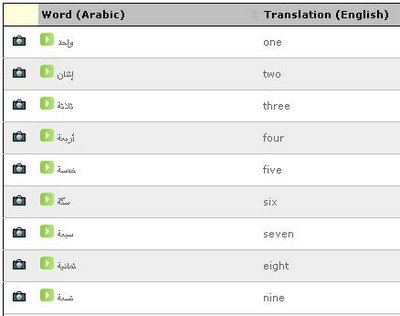 Click this button and you'll hear this word pronounced in Arabic. Of course you need to wear headphones or have your speakers on. Do you like it? These words were pronounced and recorded by a native Arabic speaker, so if you are learning Arabic then you'll be able to hone your pronunciation against these records.
At this moment Arabic is the only language that was recorded for Internet Polyglot lessons as a pilot project. We expect that eventually all languages that have lessons in our site have their words pronounced, recorded to sound files and placed to the site. Stay tuned!
Tuesday, October 10, 2006
Internet Polyglot News: Site Is Translated to Greek and Arabic
The site has been translated to two new languages: Greek and Arabic. So if you are a native Greek or Arabic speaker you can enjoy visiting and learning new languages in your native language.
To see the site in Greek: http://www.internetpolyglot.com/greek/mainMenu.html?locale=el
To see the site in Arabic: http://www.internetpolyglot.com/arabic/mainMenu.html?locale=ar
To return to English: http://www.internetpolyglot.com/mainMenu.html?locale=en
Just as a reminder: you can switch between languages using the links right under the Internet Polyglot logo:

To see the site in Greek: http://www.internetpolyglot.com/greek/mainMenu.html?locale=el
To see the site in Arabic: http://www.internetpolyglot.com/arabic/mainMenu.html?locale=ar
To return to English: http://www.internetpolyglot.com/mainMenu.html?locale=en
Just as a reminder: you can switch between languages using the links right under the Internet Polyglot logo:

Language Lessons Get Your Trip Abroad Off To A Great Start
Start your dream vacation experience early with language lessons. Many of us spend a good portion of our lives dreaming of that one huge trip abroad that will take us too many places and expose us to many new people and cultures. However, we often fail to see how important knowing the language of the lands we are visiting is to our overall vacation experience. Even the most basic needs we have while vacationing can be negatively impacted by having no understanding of the language: hotel check in, taxi rides, directions, and fares, ordering food, and getting from one place to another.
One of the biggest mistakes that English-speaking people do is assume that they will have no trouble finding someone that speaks English where they are going. Although English is the most commonly spoken language right next to Spanish, you can't assume that (or ask of) the natives will be able to communicate with you in your own language. That's why you need to make the first move and start learning theirs.
Language lessons are a great way to improve your understanding of the native language of the places you will be visiting. You can take language lessons online. These lessons are not meant to replace traditional language learning processes but to enhance the learning experience by using games, flash cards, and word scrambles to teach you the vocabulary of the language you are trying to learn and helping you to memorize words.
It doesn't matter if you want to learn French, Hindi, Russian, or improve your English skills, there are wonderful lessons and games that will help improve vocabulary while building strong language skills. You will enjoy your vacation so much more if you have at least a basic understanding of the language. I recommend at least being able to ask and understand directions, order food, and find a restroom in addition to having a basic understanding of the local currency and basic counting (this lessens your risk of being taken advantage of by not so honest vendors).
We rely on our language skills for the most basic of tasks each and every day. If you've never been in a situation where communication was impaired by a language barrier, then it is nearly impossible to explain how difficult it can be to find your way around, get food and water, and deal with monetary transactions. Knowing the language also means you can read the signs to get where you're hoping to go, find neat little places along the way you didn't know about, and have a greater overall enjoyment of your vacation experience. It's also great fun to be able to talk to people in their own language while vacationing in order to really have an authentic travel experience.
Please visit http://www.InternetPolyglot.com for free language lessons online.
One of the biggest mistakes that English-speaking people do is assume that they will have no trouble finding someone that speaks English where they are going. Although English is the most commonly spoken language right next to Spanish, you can't assume that (or ask of) the natives will be able to communicate with you in your own language. That's why you need to make the first move and start learning theirs.
Language lessons are a great way to improve your understanding of the native language of the places you will be visiting. You can take language lessons online. These lessons are not meant to replace traditional language learning processes but to enhance the learning experience by using games, flash cards, and word scrambles to teach you the vocabulary of the language you are trying to learn and helping you to memorize words.
It doesn't matter if you want to learn French, Hindi, Russian, or improve your English skills, there are wonderful lessons and games that will help improve vocabulary while building strong language skills. You will enjoy your vacation so much more if you have at least a basic understanding of the language. I recommend at least being able to ask and understand directions, order food, and find a restroom in addition to having a basic understanding of the local currency and basic counting (this lessens your risk of being taken advantage of by not so honest vendors).
We rely on our language skills for the most basic of tasks each and every day. If you've never been in a situation where communication was impaired by a language barrier, then it is nearly impossible to explain how difficult it can be to find your way around, get food and water, and deal with monetary transactions. Knowing the language also means you can read the signs to get where you're hoping to go, find neat little places along the way you didn't know about, and have a greater overall enjoyment of your vacation experience. It's also great fun to be able to talk to people in their own language while vacationing in order to really have an authentic travel experience.
Please visit http://www.InternetPolyglot.com for free language lessons online.
Friday, October 06, 2006
Early Language Learning Is Best
We all know the importance of play in early childhood and research shows that childhood is the best time to learn new languages. For this reason alone, the Internet has a great deal to offer young children developing foreign language skills. By using flashcards and matching games, children are able to build their vocabulary skills and memorize words according to the picture they belong to. Children love to play games and education can go hand in hand with the games they play. This is indeed a great combination of factors that can lead to a solid foundation for a child's language learning skills.
You cannot simply learn basic language concepts - learning to read is an added bonus. By reading recreationally in another language you are building, perhaps the greatest skills in that language and fostering a love of reading at the same time. The best of all worlds really as so much gets lost in the translation of great literature. Reading in and of itself is a great vocabulary builder in any language. As you come across a word you don't know the meaning of, look it up in the dictionary. You've just improved your vocabulary without even going to too much effort. Even if you can't be bothered to look up its exact meaning, you will be able to deduce it from the context on most occasions. This is even more important to children, who will form up a solid vocabulary early on (they'll improve their native language vocabulary at the same time as they improve the foreign language one).
You can find free online courses in many different languages. While these courses are meant to be used along with formal language lessons, they are still a great source of knowledge and education about other languages. I highly encourage you to take it one step further though and actually study the culture of the people whose language you are learning. It is so much more interesting when you can put faces to the words you are hearing.
Childhood is by far the best time to learn a foreign language. By teaching and encouraging your child about other languages and cultures you are opening the doors of the world of learning and understanding to them. Take care that you make the process fun and game like so they will wish to continue their language studies and perhaps some day surpass the lessons you are able to provide them with. If you can give your child one gift a love of learning is the best gift you can offer. Foster it early and promote it often. Your child should be successful in every endeavor with these early lessons.
You cannot simply learn basic language concepts - learning to read is an added bonus. By reading recreationally in another language you are building, perhaps the greatest skills in that language and fostering a love of reading at the same time. The best of all worlds really as so much gets lost in the translation of great literature. Reading in and of itself is a great vocabulary builder in any language. As you come across a word you don't know the meaning of, look it up in the dictionary. You've just improved your vocabulary without even going to too much effort. Even if you can't be bothered to look up its exact meaning, you will be able to deduce it from the context on most occasions. This is even more important to children, who will form up a solid vocabulary early on (they'll improve their native language vocabulary at the same time as they improve the foreign language one).
You can find free online courses in many different languages. While these courses are meant to be used along with formal language lessons, they are still a great source of knowledge and education about other languages. I highly encourage you to take it one step further though and actually study the culture of the people whose language you are learning. It is so much more interesting when you can put faces to the words you are hearing.
Childhood is by far the best time to learn a foreign language. By teaching and encouraging your child about other languages and cultures you are opening the doors of the world of learning and understanding to them. Take care that you make the process fun and game like so they will wish to continue their language studies and perhaps some day surpass the lessons you are able to provide them with. If you can give your child one gift a love of learning is the best gift you can offer. Foster it early and promote it often. Your child should be successful in every endeavor with these early lessons.
Subscribe to:
Posts (Atom)




